
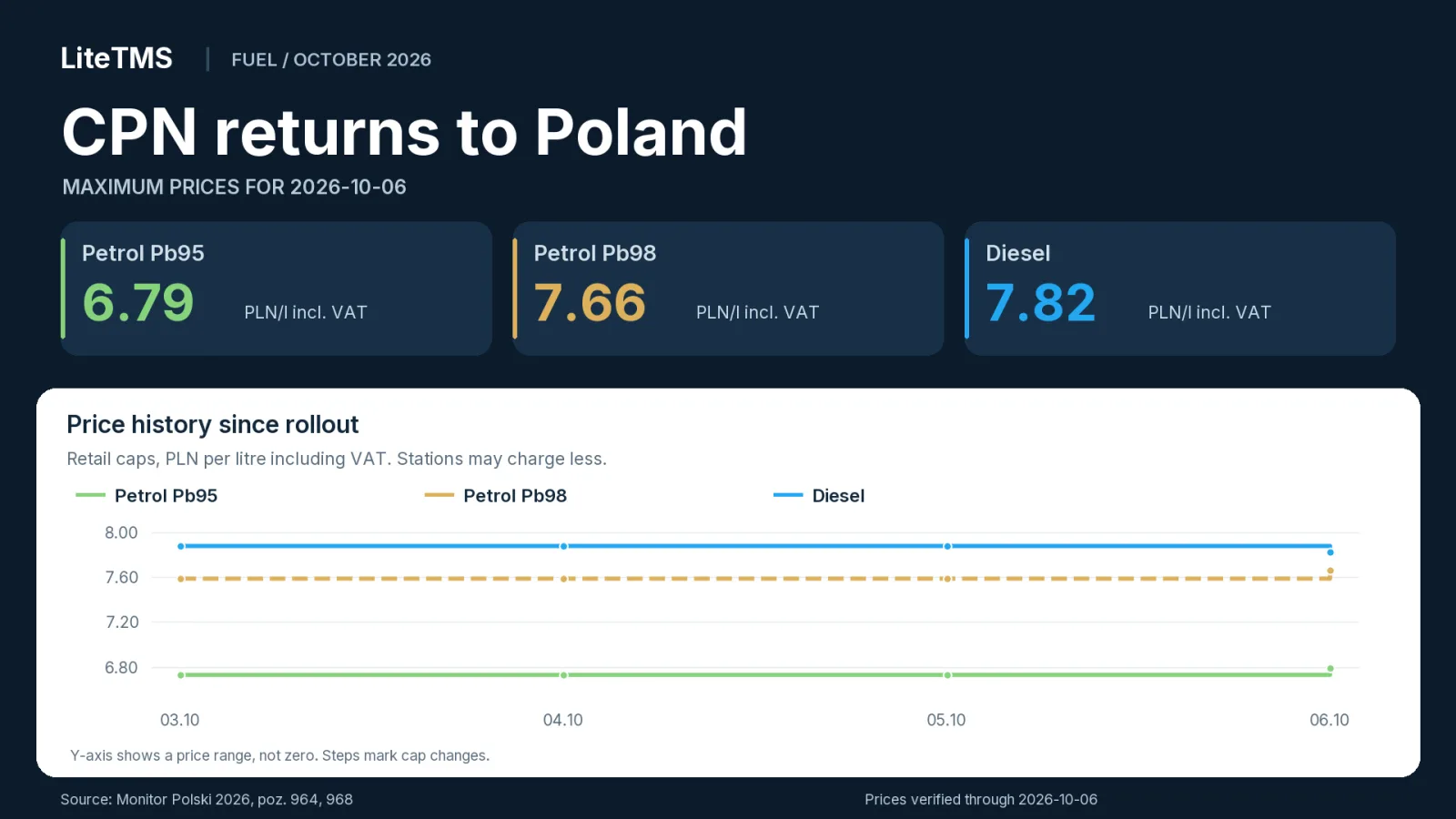
Poland's CPN package, short for “Ceny Paliwa Niżej”, returned on 3 October 2026 and is scheduled to run until the end of the year. It lowers VAT and excise on fuel and brings back maximum petrol and diesel prices. For carriers, the immediate change is in fuel bills and the fuel costs used in route quotes. Ministry of Energy announcement, 2 October.
As checked on the morning of 6 October 2026, Polish local time: the maximum prices are Pb95 petrol 6.79 PLN/l, Pb98 petrol 7.66 PLN/l and diesel 7.82 PLN/l, including VAT. Stations can charge less. The caps are set by Monitor Polski 2026, item 968.
Daily maximum fuel prices since 3 October
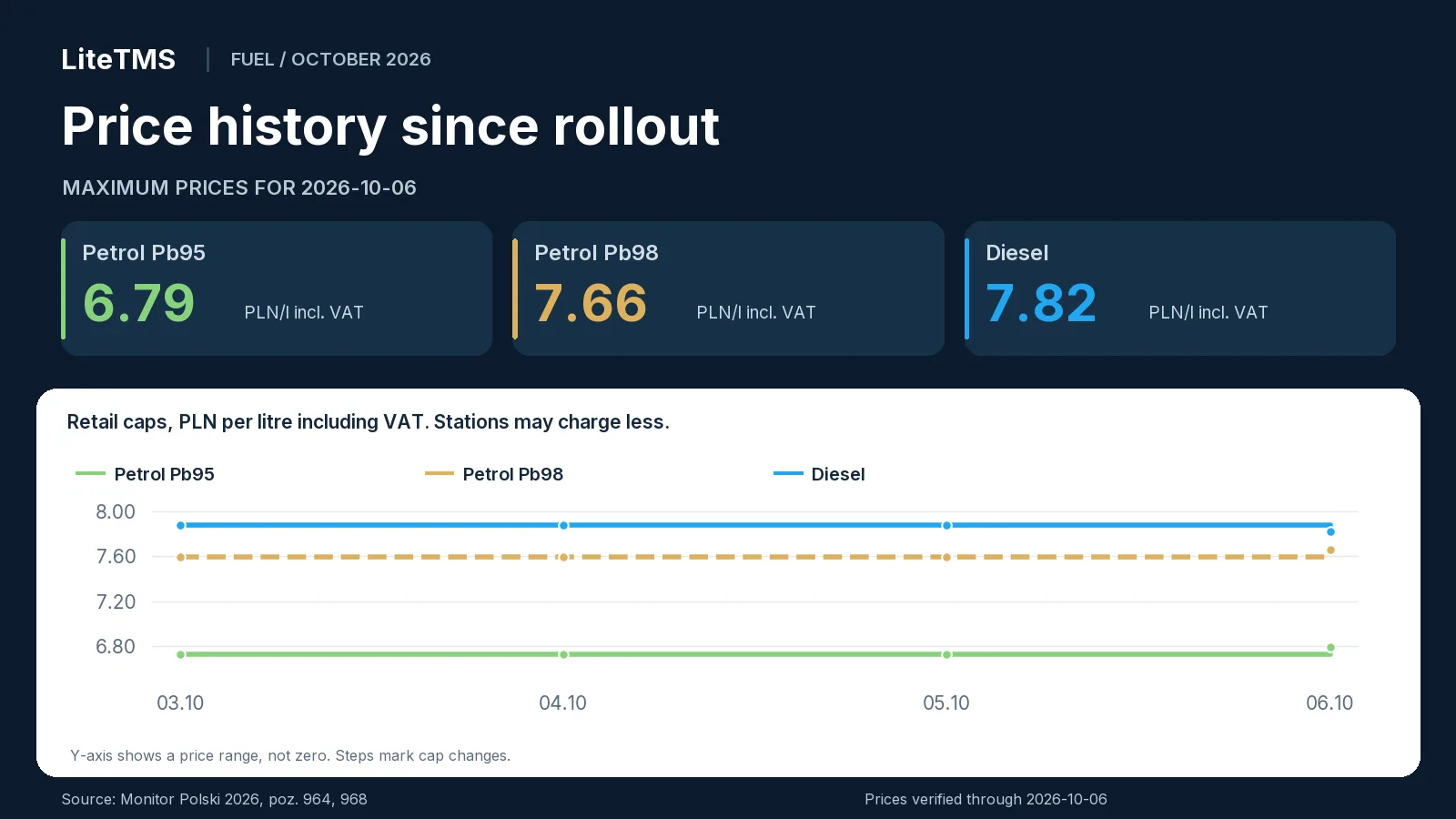
Here are the caps for each day from 3 to 6 October. They stayed unchanged for the first three days, with the first adjustment taking effect on Tuesday.
| Effective date | Pb95, PLN/l incl. VAT | Pb98, PLN/l incl. VAT | Diesel, PLN/l incl. VAT | Source |
|---|---|---|---|---|
| 2026-10-03 | 6.73 | 7.59 | 7.88 | M.P. 2026 poz. 964 |
| 2026-10-04 | 6.73 | 7.59 | 7.88 | M.P. 2026 poz. 964 |
| 2026-10-05 | 6.73 | 7.59 | 7.88 | M.P. 2026 poz. 964 |
| 2026-10-06 | 6.79 | 7.66 | 7.82 | M.P. 2026 poz. 968 |
The caps for 3, 4 and 5 October were published on 2 October, and those for 6 October on 5 October. Both notices give prices with and without VAT: original PDF, item 964 and original PDF, item 968.
What changed on 6 October
On 6 October, the Pb95 cap rose by 0.06 PLN/l and Pb98 by 0.07 PLN/l compared with the previous day. The diesel cap fell by 0.06 PLN/l.
Buying 600 litres of diesel at the maximum price would cost 4,728 PLN including VAT on 5 October and 4,692 PLN the next day. That is 36 PLN less for one fill. For a purchase of 10,000 litres, the difference is 600 PLN.
October is the third CPN round of 2026
This is the third CPN round of 2026. In spring, 8% VAT applied from 31 March through 30 June, while reduced excise ran from 30 March through 15 June. Lower VAT returned from 17 through 31 August. The October package reduces both taxes again. Finance Ministry and KAS recap, 2 October.
VAT, excise and the fuels covered
From 3 October through 31 December 2026, VAT on fuel covered by the package is 8% instead of 23%. The reduction covers the petrol and diesel products listed in the regulation, qualifying blends with biocomponents, and biocomponents used as standalone fuel if they meet the quality requirements. VAT regulation, Dz.U. 2026 item 1288, § 1.
Reduced excise is 1,239 PLN per 1,000 litres of petrol and 880 PLN per 1,000 litres of diesel and the specified biocomponents, for the same period. Excise regulation, Dz.U. 2026 item 1289, § 1.
According to the Finance Ministry, the excise cut alone is 0.29 PLN/l for petrol and 0.28 PLN/l for diesel. The ministry estimates that the package will reduce pump prices by roughly 1.20 to 1.30 PLN/l overall. Finance Ministry / KAS announcement, 2 October.
The price caps cover Pb95 petrol, Pb98 petrol and diesel. LPG falls outside these caps and the VAT reduction described here. Products marketed as premium follow the rules for their fuel classification; a brand name does not create a separate price category. Fuel scope in item 968, VAT regulation.
How the cap works, including weekends
The cap is based on average wholesale prices from five leading market participants. The calculation includes excise, the fuel fee, VAT and 0.30 PLN/l for station operating costs. A new cap applies from the day after publication. A notice issued before a weekend covers the weekend and the next working day. Mechanism explained in V10's 3 October report.
That is what happened at the start of October: the Friday notice of 2 October set prices for Saturday, Sunday and Monday. The next caps took effect on Tuesday, 6 October.
The cap applies to every station in Poland, including motorway sites. It lets a carrier check whether a pump price falls within the allowed amount. The cost recorded for a transport job is the actual price paid on the invoice. Ministry of Energy rules announced on 2 October.
How the windfall tax relates to CPN
The government links funding for the relief to a windfall tax on fuel businesses. The law published on 1 October covers fuel producers and businesses licensed for foreign fuel trade.
Its taxable period runs from 1 March 2026 through 31 March 2027. The rate is 60% of the tax base defined in the law. For specified businesses that do not produce fuel, tax payable is capped at 50% of the relevant income or profit. Dz.U. 2026 item 1287, articles 4, 5, 7 and 8.
Most provisions take effect on 1 November. Article 11, which allows the excise reduction, took effect earlier, on 2 October. This allowed lower excise to apply from the following day. The same law, articles 11 and 14.
The President signed the law on 1 October and announced that it would be referred to the Constitutional Tribunal for review. President's official record, 1 October.
A carrier buying fuel for its vehicles does not become liable for this tax through that purchase. The obligation applies to the fuel-sector activities specified in the law.
What changes for carriers, forwarders and freight buyers
A carrier with its own fleet feels the change directly at the pump. Lower bills can ease cash flow. Profit on a route also depends on the fuel's net price, consumption, discounts and the rate agreed with the customer. For a forwarder using subcontractors, CPN's effect comes through transport prices or fuel surcharges.
Here is what to check in daily work:
- Carriers: use the new fuel prices when quoting routes. Calculate costs for completed jobs from actual purchases during the period when they ran.
- Forwarders: check the fuel surcharge reference in the contract. It may use retail prices, wholesale prices, a monthly index or another agreed measure.
- Freight buyers: fuel is one component of a transport price. Wages, tolls, vehicle finance and empty mileage remain part of the calculation.
- Stations and suppliers: price lists and settlements must reflect the new taxes and caps. The cap includes 0.30 PLN/l for station operating costs.
For international routes, calculate fuel costs separately for each country of purchase. Polish caps apply only to purchases at stations in Poland.
Fuel prices with and without VAT
The gross price is the amount paid at the pump. The net price is the fuel's value before VAT. The caps for 6 October are:
| Fuel | Official cap excluding VAT, PLN/l | Official cap including VAT, PLN/l |
|---|---|---|
| Pb95 | 6.29 | 6.79 |
| Pb98 | 7.09 | 7.66 |
| Diesel | 7.24 | 7.82 |
Source: original notice, M.P. 2026 item 968.
Lower VAT can reduce the bill even when the net fuel price stays the same. For example, fuel priced at 7.00 PLN/l before VAT costs 8.61 PLN/l with 23% VAT and 7.56 PLN/l with 8% VAT. The payment falls by 1.05 PLN/l while the net price remains 7.00. The effect on business costs depends on how the business accounts for VAT.
Take a 1,000 km route at 30 l/100 km: it needs 300 litres of diesel. Buying that fuel at the maximum price, without discounts, would cost 2,346 PLN including VAT or 2,172 PLN before VAT on 6 October. The gross cost is 2.346 PLN/km. For the same route and consumption the previous day, the cost would be 2,364 PLN gross or 2,190 PLN net, 18 PLN more.
Compare actual invoice prices on the same basis: net or gross. Calculate fuel surcharges using the reference agreed in the contract.
How long the package lasts and how prices can change
The Ministry of Energy links the return to high prices and market instability, including events in the Middle East and around the Strait of Hormuz. Ministry announcement, 2 October.
The current edition is scheduled to run through 31 December 2026. During that period, caps can rise or fall with new notices. The first change came on 6 October, when petrol caps rose and diesel's fell. Following the latest caps helps keep fleet budgets current.
What the daily follow-ups will contain
The daily follow-ups will give that day's caps, the change against the previous day and a short recap of recent prices. Each dated table will include sources and a chart running from 3 October. Updates will appear in the blog archive.
Sources and verification date
The data was checked on the morning of 6 October 2026. Prices come from Monitor Polski, tax rates from published regulations, and the programme details from October announcements and reporting. Source links appear beside the relevant information.
Questions people ask
- What are Poland's maximum fuel prices on 6 October 2026?
- Pb95 petrol is capped at 6.79 PLN/l, Pb98 at 7.66 PLN/l and diesel at 7.82 PLN/l, including VAT. M.P. 2026 item 968 establishes those daily limits; a station's actual price may be lower.
- What were the caps on 3, 4 and 5 October 2026?
- On each day, the VAT-inclusive caps were 6.73 PLN/l for Pb95, 7.59 PLN/l for Pb98 and 7.88 PLN/l for diesel. All three days were covered by M.P. 2026 item 964.
- When does the October CPN package end?
- It runs from 3 October through 31 December 2026, according to the Ministry of Energy announcement. Maximum prices are set in successive notices during that period.
- Does the CPN package cover LPG?
- LPG is outside these price caps and the VAT reduction described here. The package covers the fuels listed in notice 968 and the VAT regulation.
- Does a transport company have to pay the windfall tax?
- Buying fuel for vehicles does not create that obligation. The tax covers fuel producers and businesses trading under a foreign fuel-trade licence, as specified in article 5 of Dz.U. 2026 item 1287.
- Does lower VAT save a business the full fall in the gross price?
- Lower VAT reduces the gross payment even if the net price stays the same. The effect on business costs depends on how the business accounts for VAT, so compare actual purchase prices on the same basis: net or gross.
Keep in touch
Make room for better reads.
Choose LiteTMS as a preferred source to find more of our articles on Google.
Choose LiteTMS on GoogleConfirm your choice on Google · Opens in a new tab