
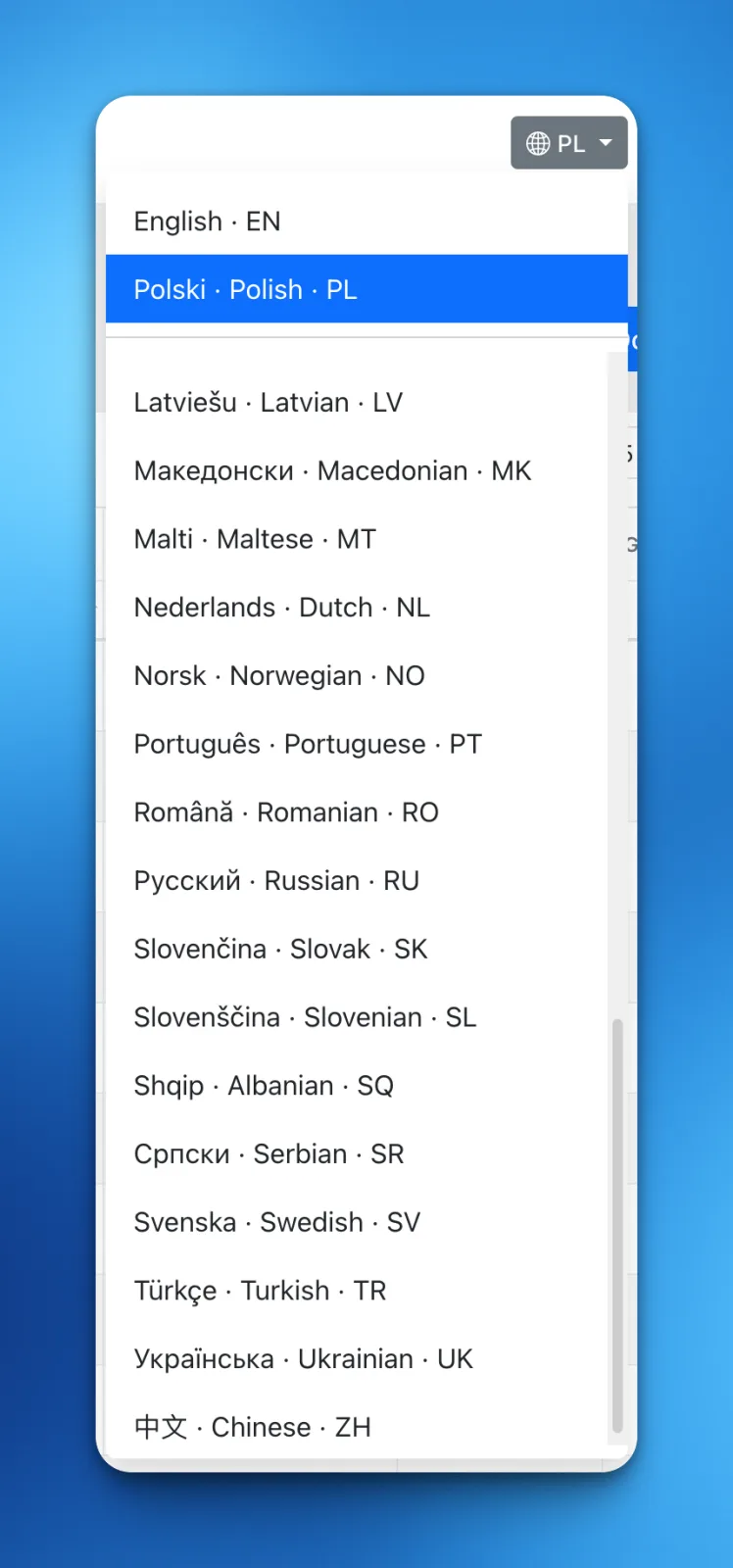
Four days after announcing 27 interface languages, LiteTMS already has 41. Conversations with contractors showed us which languages their teams actually needed, so an intense weekend turned that feedback into a wider web panel and mobile app.
We did not expect to write this follow-up so soon
A few days ago, we published a post about 27 interface languages and chat translation into 184 languages. We expected that update to stand for a while.
Then we spoke with contractors. They were not interested in how impressive 27 looked in a picker. They told us where their drivers came from, who their forwarding teams worked with and which languages people actually used to read instructions on the road.
Those conversations gave us a clear list of what was missing. We could have put it on a future roadmap. Instead, we got to work.
Fourteen more languages
By the end of the weekend, the interface list had grown from 27 to 41. Alongside Polish, English, German, Ukrainian and Romanian, it now includes Chinese, Hindi, Japanese, Georgian and Azerbaijani.
That matters because transport companies do not work only with contractors from Europe. Drivers come from many parts of the world too. A company can operate from Poland, handle work for a contractor in Asia and have a driver who understands instructions best in Hindi.
That team should not need one shared language just to use its software. Every user can choose their own.
This time the mobile app is included too
Our previous post focused on the web panel and translated conversations. The new list of 41 now covers the full LiteTMS interface used for daily work, including the mobile app for drivers and forwarders.
A forwarder can manage an order in Polish while the driver opens it in an app set to Ukrainian, Chinese or another preferred language. Menus, buttons, forms and messages follow the individual user. One person's choice does not change the language for everyone else at the company.
This was the part that mattered most to us. A multilingual office panel is not much help if the driver leaves the office and lands back in a language they do not understand.
Chat still translates into 184 languages
The number 41 covers the interface of the web panel and mobile app. A separate list of 184 languages still handles translations of chat messages, company news and voice note transcripts.
That means people can set the whole product to their own language and still translate a message that arrived from somewhere completely different.
This update started with conversations. If a language that matters to your team is still missing, tell us. Messages like that go straight into the work plan, sometimes as soon as the next weekend.
Questions people ask
- How many interface languages does LiteTMS support?
- The LiteTMS web system supports 41 interface languages. The list includes European languages as well as Chinese, Hindi, Japanese, Georgian and Azerbaijani.
- Does the LiteTMS mobile app also support 41 languages?
- Yes. The mobile interface for drivers and forwarders is available in the same 41 languages, and each person chooses independently of the rest of the team.
- What is the difference between the 41 languages and 184 chat languages?
- The 41 languages cover interface elements such as menus, buttons, forms and messages. The 184-language list is used to translate content such as chat messages, company news and voice note transcripts.
- Does LiteTMS support languages from outside Europe?
- Yes. The list includes Chinese, Hindi and Japanese because European transport companies work with contractors and employees from around the world.
Keep in touch
Make room for better reads.
Choose LiteTMS as a preferred source to find more of our articles on Google.
Choose LiteTMS on GoogleConfirm your choice on Google · Opens in a new tab